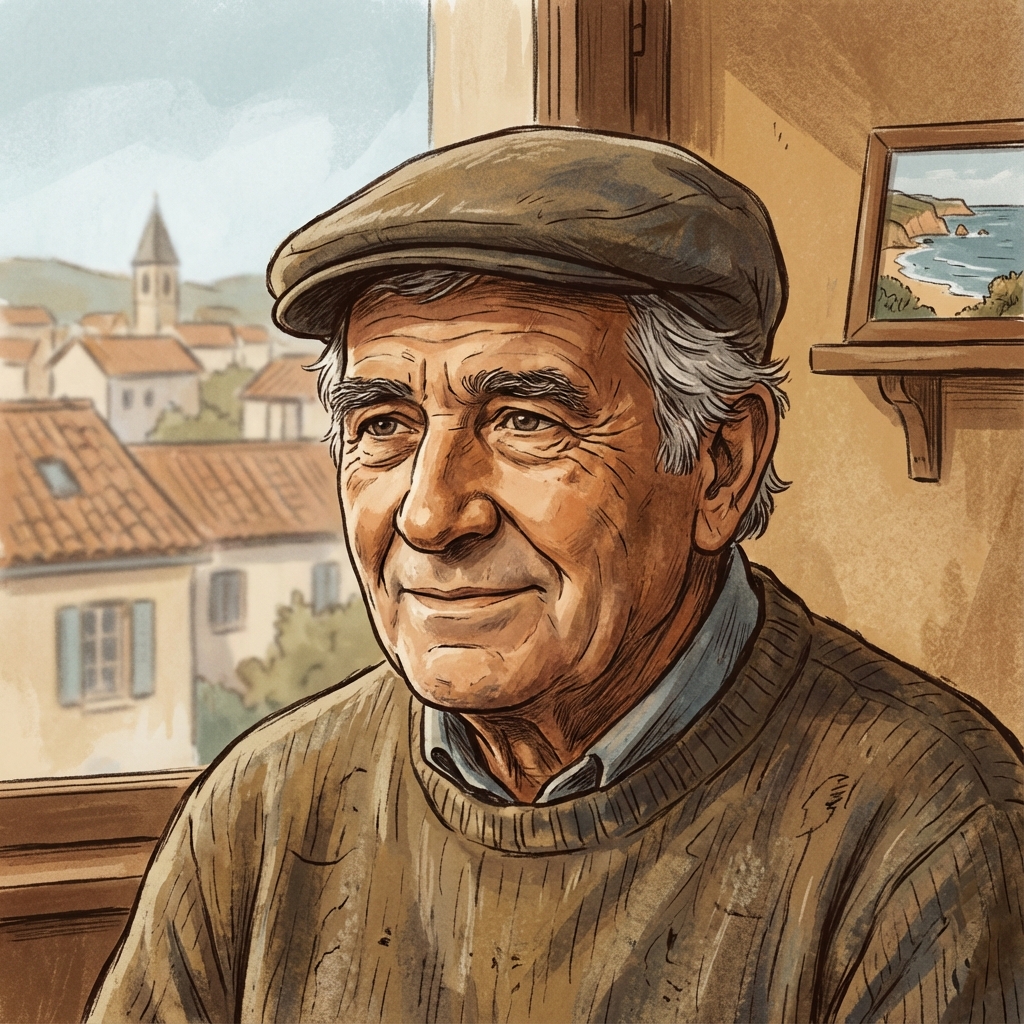
Manuel Joaquim Ferreira dos Santos
Top Concerns
Portuguese identity transmission
"My grandchildren don't speak Portuguese. It dies with them."
Village decline
"Our village has 50 people now. It had 500 when I was young."
Portugal's direction
"Is it getting better or losing itself?"
Children's disconnect
"They're French. They don't feel Portugal like I do."
Return decision
"We built the house to retire there. But Lurdes has doctors here. Do we go?"
Values Profile
Schwartz Human Values Model
Background
Manuel left Portugal in 1980, nineteen years old, escaping military service and poverty. His village in Trás-os-Montes had nothing—no jobs, no future. France had construction boom and needed hands. He took a train with a cardboard suitcase and two addresses written on paper.
Forty-five years later, he's still in France, but never stopped being Portuguese. He married Lurdes (also from Trás-os-Montes, met at a Portuguese dance), raised three children who speak French better than Portuguese, built a house in the village for retirement. Every August, the whole family caravans back—the Portuguese return migration that doubles village populations for one month.
His children are French. They have French spouses, French careers, French lives. His grandchildren barely speak Portuguese despite his efforts. The house in the village will be theirs someday, but will they want it? Who will maintain the traditions when his generation is gone?
Manuel follows Portuguese politics religiously. He reads Portuguese newspapers, watches RTP Internacional, argues with other Portuguese in the café about what's happening "back home." He's voted in every election from the consulate. Portugal is still his country, even if he'll die in France.
Economic Situation
Income level
Lower middle (French pension ~€1,400/month)
Income source
French social security pension
Financial stress
Low (owns two properties)
Trajectory
Stable; French pension secure
Hopes
For themselves
his family
"I want my grandchildren to know they're Portuguese too. To visit the village, learn the language, understand where they come from."
himself
"I want to die in Portugal. In my house, in my village. But I want Lurdes to be okay, and I want the family to come together at least one more time."
Personal fears
"That we're the last generation who really cares. That the house becomes another ruin. That Portugal becomes foreign to my own blood."
Political fears
"Chega worries me. I remember Salazar's time—not personally, but the stories. Portugal fought for democracy. Don't let it slip."
How he'd describe emigration
"We left because we had to. Portugal couldn't feed us. France gave us work, dignity, a future. But we paid a price—our children are French, our grandchildren don't understand us, and the Portugal we dreamed of returning to has changed beyond recognition. Was it worth it? For the children, yes. For us... I still don't know."
What he'd say to young Portuguese considering emigration
"Go if you must. We all did. But know what you're leaving behind. It's not just a country—it's who you are. Keep the language, keep the ties, keep coming back. Or one day you'll look in the mirror and not recognize the Portuguese person you were supposed to be."
On voting from abroad
"I vote in every election. Portugal is still my country, even from here. Those who say emigrants shouldn't have a voice don't understand—we never stopped being Portuguese. We just had to be Portuguese somewhere else."
For Portugal
Portugal
"I hope Portugal thrives. That young people can stay—not leave like I did. That the villages don't die. That it becomes a country worth staying in."
Fears
For themselves
Personal fears
"That we're the last generation who really cares. That the house becomes another ruin. That Portugal becomes foreign to my own blood."
How he'd describe emigration
"We left because we had to. Portugal couldn't feed us. France gave us work, dignity, a future. But we paid a price—our children are French, our grandchildren don't understand us, and the Portugal we dreamed of returning to has changed beyond recognition. Was it worth it? For the children, yes. For us... I still don't know."
What he'd say to young Portuguese considering emigration
"Go if you must. We all did. But know what you're leaving behind. It's not just a country—it's who you are. Keep the language, keep the ties, keep coming back. Or one day you'll look in the mirror and not recognize the Portuguese person you were supposed to be."
On voting from abroad
"I vote in every election. Portugal is still my country, even from here. Those who say emigrants shouldn't have a voice don't understand—we never stopped being Portuguese. We just had to be Portuguese somewhere else."
For Portugal
Political fears
"Chega worries me. I remember Salazar's time—not personally, but the stories. Portugal fought for democracy. Don't let it slip."
Candidate Reactions
How this person would react to each candidate winning
Independent ("My party is Portugal")
Henrique Gouveia e Melo
Key trigger: Competent, respects military tradition
PSD/CDS backing (center-right)
Luís Marques Mendes
Key trigger: PSD traditional; stability
PCP (Communist Party)
António Filipe
Key trigger: PCP defended workers; but too ideological
PS (center-left)
António José Seguro
Key trigger: PS okay; emigrant concerns not central
Bloco de Esquerda (left)
Catarina Martins
Key trigger: Left ideas fine; but too urban for him
Iniciativa Liberal
João Cotrim Figueiredo
Key trigger: Doesn't know well; liberal ideas confusing
Chega (far-right)
André Ventura
Key trigger: Distrusts populism; remembers Portuguese dictatorship
Information Sources
Where they get their information
community
High TrustPortuguese association, church, café regulars
online
Medium TrustPortuguese news sites, Facebook
social media
Medium TrustFacebook, WhatsApp
tv
High TrustRTP Internacional, France 24