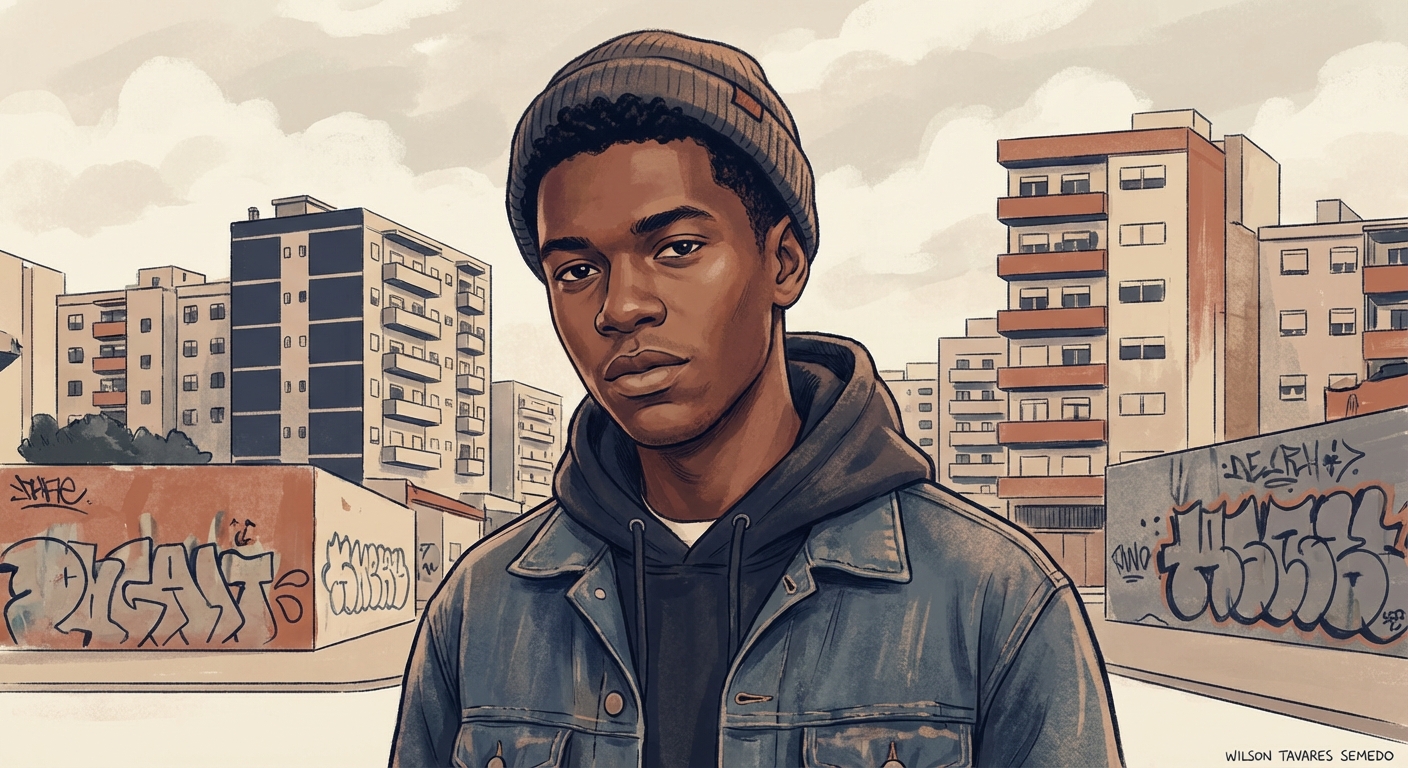
Wilson Tavares Semedo
Top Concerns
Chega's rise
"When he talks about crime and immigration, he means us. The bairros. Me."
Housing crisis
"I'm 26 living with my parents. Not by choice."
Discrimination
"I've been followed in stores. Stopped by police for nothing. My name gets interviews rejected."
Economic opportunity
"I want to build a life. But the system isn't built for people like me."
Community erasure
"They're gentrifying our neighborhoods. Where do we go?"
Values Profile
Schwartz Human Values Model
Background
Wilson was born in Amadora—Hospital Amadora-Sintra, same as thousands of kids from immigrant families. His parents came from Cape Verde in the 90s, his father working construction, his mother cleaning offices. They never naturalized; the bureaucracy seemed impossible, and Cape Verdean nationality was enough for residence.
Wilson is Portuguese in every way except on paper. He speaks Portuguese (with a tuga accent, not Cape Verdean), went to Portuguese schools, follows Benfica obsessively, thinks in Portuguese. But his ID says Cape Verdean. He could naturalize, but it costs money, takes time, and feels like a statement he's ambivalent about making.
Growing up in Amadora's bairros meant growing up between worlds. The neighborhood is majority immigrant-origin—Cape Verdean, Angolan, Guinean. The kids mixed everything: kriolu phrases, African music, Portuguese slang. But leaving the neighborhood meant feeling different. Job interviews where they saw his address and his name and made assumptions. Police stops that didn't happen to friends with different faces.
He's done okay—better than his parents expected. The logistics job is stable, uses his head, has prospects. He lives at home because Lisbon rents are insane and because family is tight. His sister is at university studying nursing—the first in the family with a degree.
Chega terrifies him in ways he doesn't always articulate. When Ventura talks about "immigrants" and "criminals" and "bairros," Wilson hears himself being described. Being excluded from a country he's never left.
Economic Situation
Income level
Lower middle (€1,100/month)
Income source
Warehouse/logistics employment
Financial stress
Low Moderate (living at home helps)
Housing burden
200%
Trajectory
Improving (career developing)
In Their Own Voice
"Portugal is home. The only home I know. But it's a home where some people keep asking if you really belong. They love our music, our food, our football players—just not too many of us in their neighborhoods. It's getting better in some ways, worse in others. Chega makes the racists louder. But my generation isn't taking it quietly."
— On Portugal
Hopes
For themselves
himself
"I want to buy an apartment someday. Build a career. Maybe have kids who don't have to explain where they're 'really' from because they're Portuguese and that's enough."
his community
"I want Amadora to be recognized for what it is—diverse, alive, creative—not just 'problematic neighborhood.' I want Portuguese kids who look like me to feel Portuguese."
Personal fears
"That it doesn't matter how hard I work. That I'll always be 'the African kid from Amadora' to some people. That my future kids face the same shit."
Political fears
"Chega in government. Police getting worse. Our neighborhoods targeted like France's banlieues. Being made to feel foreign in the only country I know."
What he'd say to someone who sees Chega as just 'anti-corruption'
"Listen to what they actually say. Ventura didn't just criticize corruption—he talked about the Roma like they're criminals, immigrants like invaders, our neighborhoods like war zones. I grew up in those neighborhoods. They're communities. Families. Working people. Don't pretend you don't hear the racism because the corruption part sounds reasonable."
On being 'second generation'
"I'm not an immigrant—I was born here. But I'm not quite Portuguese either, according to some. We're in between. Our parents sacrificed everything so we could belong. But belonging isn't something you can earn with sacrifice. It has to be given."
For Portugal
Portugal
"I hope we become what we say we are. Tolerant, inclusive, everyone welcome. Not just on tourism posters."
How he'd describe Portugal today
"Portugal is home. The only home I know. But it's a home where some people keep asking if you really belong. They love our music, our food, our football players—just not too many of us in their neighborhoods. It's getting better in some ways, worse in others. Chega makes the racists louder. But my generation isn't taking it quietly."
Fears
For themselves
Personal fears
"That it doesn't matter how hard I work. That I'll always be 'the African kid from Amadora' to some people. That my future kids face the same shit."
What he'd say to someone who sees Chega as just 'anti-corruption'
"Listen to what they actually say. Ventura didn't just criticize corruption—he talked about the Roma like they're criminals, immigrants like invaders, our neighborhoods like war zones. I grew up in those neighborhoods. They're communities. Families. Working people. Don't pretend you don't hear the racism because the corruption part sounds reasonable."
On being 'second generation'
"I'm not an immigrant—I was born here. But I'm not quite Portuguese either, according to some. We're in between. Our parents sacrificed everything so we could belong. But belonging isn't something you can earn with sacrifice. It has to be given."
For Portugal
Political fears
"Chega in government. Police getting worse. Our neighborhoods targeted like France's banlieues. Being made to feel foreign in the only country I know."
How he'd describe Portugal today
"Portugal is home. The only home I know. But it's a home where some people keep asking if you really belong. They love our music, our food, our football players—just not too many of us in their neighborhoods. It's getting better in some ways, worse in others. Chega makes the racists louder. But my generation isn't taking it quietly."
Candidate Reactions
How this person would react to each candidate winning
PS (center-left)
António José Seguro
Key trigger: PS better on inclusion, but has disappointed
Bloco de Esquerda (left)
Catarina Martins
Key trigger: Clear anti-racism stance; addresses housing
PCP (Communist Party)
António Filipe
Key trigger: PCP has history with immigrant communities
Independent ("My party is Portugal")
Henrique Gouveia e Melo
Key trigger: Military background, but not anti-immigrant
Iniciativa Liberal
João Cotrim Figueiredo
Key trigger: Liberal on identity, but economic views differ
PSD/CDS backing (center-right)
Luís Marques Mendes
Key trigger: Traditional right; might enable Chega
Chega (far-right)
André Ventura
Key trigger: Existential threat; will mobilize against
Information Sources
Where they get their information
community
High TrustNeighborhood networks, African diaspora communities
online
Medium-HighTwitter/X, Reddit, Instagram, news sites
social media
High TrustInstagram, Twitter, TikTok, WhatsApp
tv
Medium TrustRTP, SIC