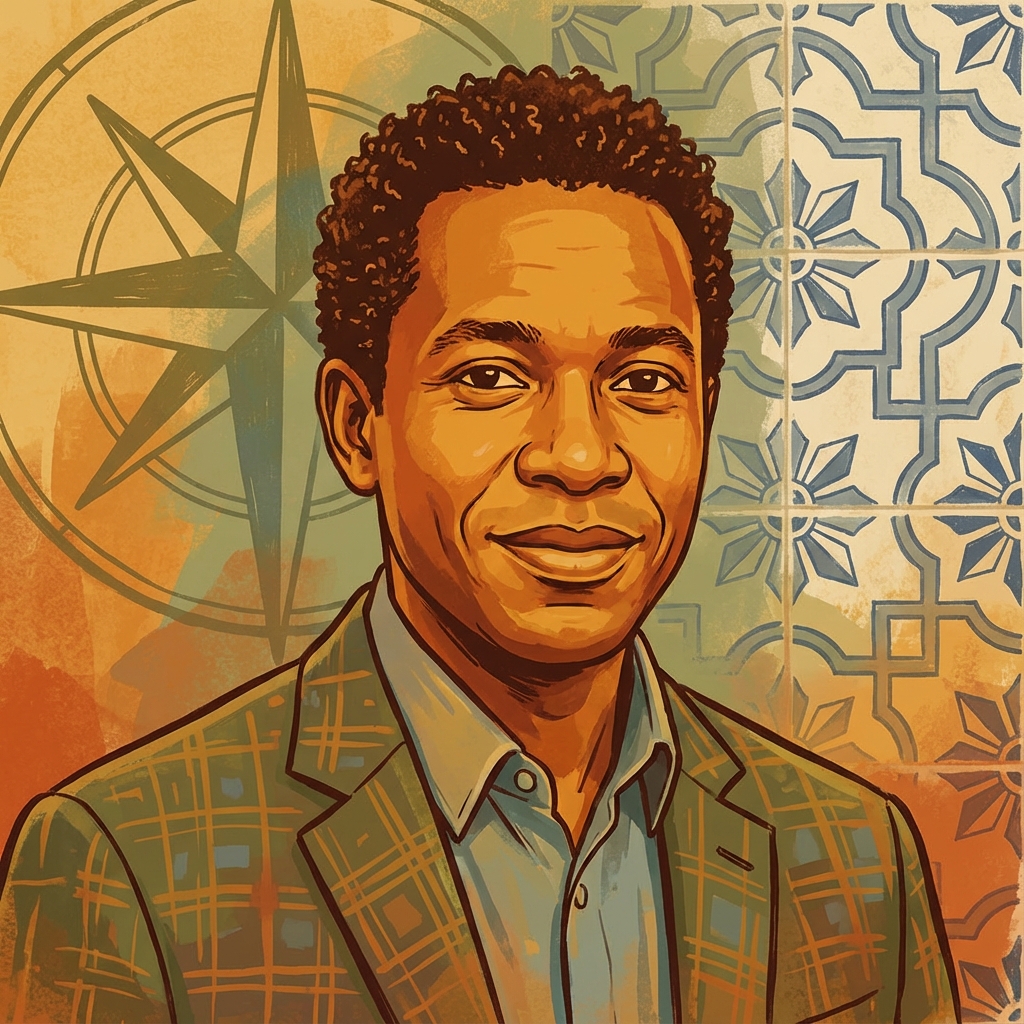
Celestino Manuel Domingos
Top Concerns
Children's future
"Will they face discrimination despite doing everything right?"
Career ceiling
"I've hit levels where 'cultural fit' means 'Portuguese.'"
Healthcare
"SNS for routine things. Anything serious, I worry."
Political trajectory
"Chega reminds me of populists destroying African countries."
Angola connection
"My mother is getting old. I can't be there for her."
Values Profile
Schwartz Human Values Model
Background
Celestino left Angola in 2017, not as a refugee but as a calculated emigration. He was doing well in Luanda—IT pays decently in Angola's oil economy—but the corruption, the lack of prospects for his children, the feeling that talent mattered less than connections drove him out. Portugal was the obvious choice: language, colonial ties (complicated as those are), a European future for his kids.
The adjustment was harder than expected. His Angolan degree wasn't fully recognized; he had to take additional certifications. His first years were underemployed—IT support roles beneath his experience. Portuguese employers saw "African degree" and assumed it was inferior. He proved them wrong, eventually landing a proper systems admin role, but the taste of that dismissal lingers.
Colonial history weighs on his relationship with Portugal. His grandfather worked on Portuguese cocoa plantations. His father fought for independence. Now Celestino lives in the former metropole, speaks the colonizer's language, sends his children to Portuguese schools. The irony isn't lost on him. He's made peace with it—pragmatism over principle—but he notices when Portuguese people romanticize colonialism or complain about "too many Africans."
His children are adapting faster than he is. His daughter wants to study medicine—in Portugal, in Portuguese. His son has a Portuguese accent now. They're becoming Portuguese in ways Celestino never will be.
Economic Situation
Income level
Upper middle (€2,800/month + wife's €1,600)
Income source
Skilled employment (stable)
Financial stress
Low Moderate
Housing burden
27%
Trajectory
Stable but ceiling possible (outsider status in corporate)
In Their Own Voice
"Portugal is not what it was when I arrived. More diverse, more alive, but also more contested. There's a tension now—who belongs, who's really Portuguese, who gets to define Portugal. I've contributed to this country. My taxes, my work, my children. But there are people who look at me and still see 'the African.' Eight years later."
— On Portugal
Hopes
For themselves
himself
"I want to see my children succeed. To be recognized for what I've built. To one day feel fully settled—neither guest nor invader."
his children
"I want them to have the choices I didn't. To be doctors, engineers, leaders—and to be seen as Portuguese who happen to have Angolan heritage, not the other way around."
Personal fears
"That my children are treated differently despite being raised here. That there's a ceiling I can't see until I hit it. That I'll need to go back to Angola someday and it will be too late."
Political fears
"Chega in power. The normalization of racism. My children's generation having to fight battles I thought were won."
What he'd say to Portuguese people who worry about immigration
"Your parents or grandparents emigrated. France, Germany, Brazil, Angola even—Portuguese went everywhere. They were treated sometimes well, sometimes badly. Now it's the reverse. Treat people how you'd want your family treated abroad. It's not complicated."
On colonial history
"I don't need apologies. I need honesty. Portugal built wealth on African labor. My grandfather's labor. Acknowledging that isn't blaming living Portuguese—it's just history. But when people romanticize colonies or complain that Africans 'invaded' Portugal... that I won't accept."
For Portugal
Portugal
"I hope Portugal matures into its diversity. Recognizes that immigrants built this country alongside the Portuguese. That we're adding to Portugal, not taking from it."
How he'd describe Portugal today
"Portugal is not what it was when I arrived. More diverse, more alive, but also more contested. There's a tension now—who belongs, who's really Portuguese, who gets to define Portugal. I've contributed to this country. My taxes, my work, my children. But there are people who look at me and still see 'the African.' Eight years later."
Fears
For themselves
Personal fears
"That my children are treated differently despite being raised here. That there's a ceiling I can't see until I hit it. That I'll need to go back to Angola someday and it will be too late."
What he'd say to Portuguese people who worry about immigration
"Your parents or grandparents emigrated. France, Germany, Brazil, Angola even—Portuguese went everywhere. They were treated sometimes well, sometimes badly. Now it's the reverse. Treat people how you'd want your family treated abroad. It's not complicated."
On colonial history
"I don't need apologies. I need honesty. Portugal built wealth on African labor. My grandfather's labor. Acknowledging that isn't blaming living Portuguese—it's just history. But when people romanticize colonies or complain that Africans 'invaded' Portugal... that I won't accept."
For Portugal
Political fears
"Chega in power. The normalization of racism. My children's generation having to fight battles I thought were won."
How he'd describe Portugal today
"Portugal is not what it was when I arrived. More diverse, more alive, but also more contested. There's a tension now—who belongs, who's really Portuguese, who gets to define Portugal. I've contributed to this country. My taxes, my work, my children. But there are people who look at me and still see 'the African.' Eight years later."
Candidate Reactions
How this person would react to each candidate winning
Independent ("My party is Portugal")
Henrique Gouveia e Melo
Key trigger: Competent, organized, not ideological
PSD/CDS backing (center-right)
Luís Marques Mendes
Key trigger: Stable, experienced, moderate
Bloco de Esquerda (left)
Catarina Martins
Key trigger: Values inclusion stance
Iniciativa Liberal
João Cotrim Figueiredo
Key trigger: Merit-based, reformist
PS (center-left)
António José Seguro
Key trigger: PS has been okay on immigration
PCP (Communist Party)
António Filipe
Key trigger: PCP history with PALOP, but outdated
Chega (far-right)
André Ventura
Key trigger: Anti-African rhetoric; populism he recognizes
Information Sources
Where they get their information
community
High TrustAngolan diaspora networks, professional contacts
online
Medium-HighLinkedIn, Público, Expresso, tech news
social media
Medium TrustLinkedIn, WhatsApp, Facebook
tv
Medium TrustRTP, SIC, some Angolan TV