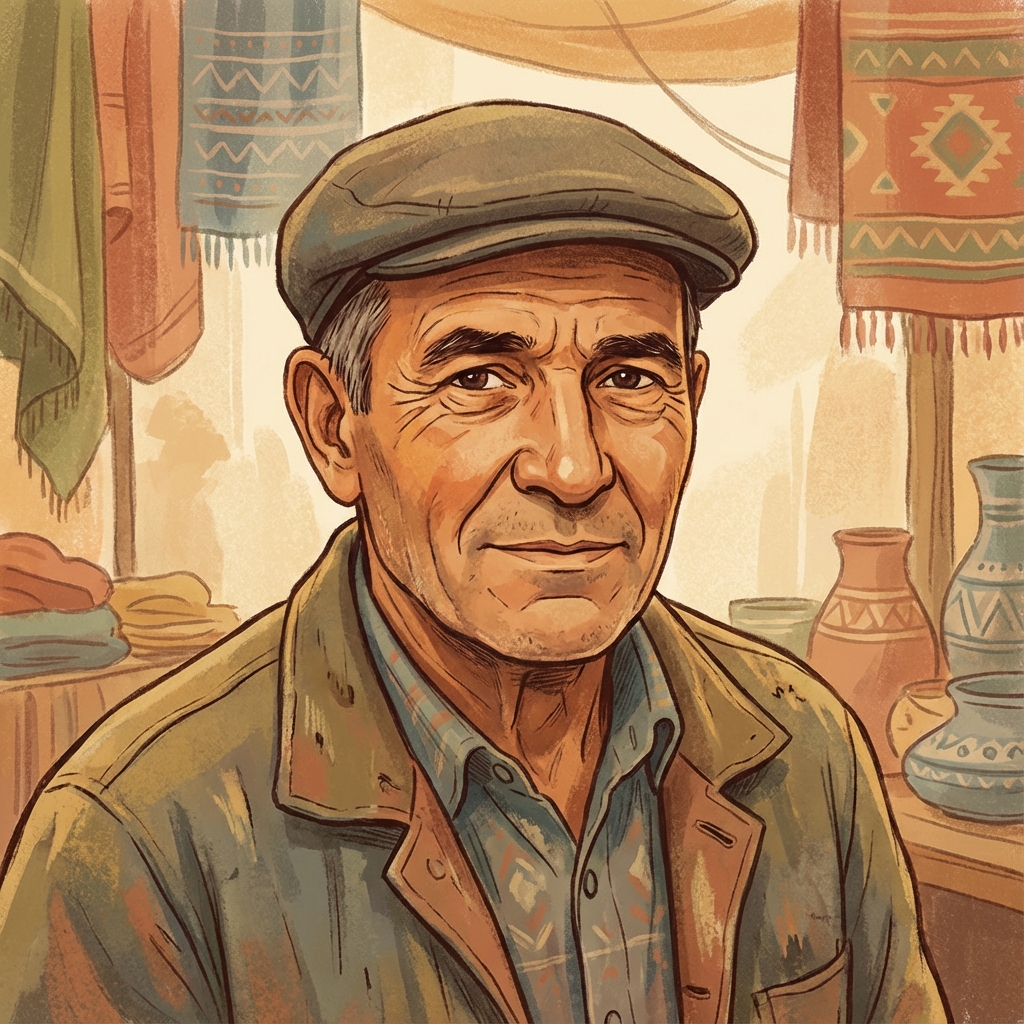
Sérgio Monteiro
Top Concerns
Chega's rise
"They talk about us like animals. What if they get power?"
Children's future
"Will my daughter face the same closed doors I did?"
Economic survival
"Markets are dying. What do we do next?"
Discrimination
"We're Portuguese. Five hundred years. Still treated as invaders."
Cultural preservation
"My kids need to know who they are. But the world punishes Roma identity."
Values Profile
Schwartz Human Values Model
Background
Sérgio's family has been in Portugal for generations—longer than most Portuguese can trace their own lineage. But being Roma (Cigano in Portuguese) means being permanently "other." His grandparents lived in caravans; his parents were pushed to informal settlements; he was relocated to social housing that feels like a ghetto by design.
He grew up with the looks, the muttered comments, the shop owners watching him. His children experience the same. His daughter is the brightest in her class—her teacher told him she could go to university. What university would want a Cigana? What employer would hire her? The ceiling is visible from birth.
The Chega phenomenon terrifies him. Ventura's rhetoric about Roma isn't subtle—he's called for their "integration or expulsion," linked them to crime, made them convenient scapegoats. For Sérgio, every Chega vote is a message: you don't belong here. The country your family has lived in for five centuries doesn't want you.
He sells at weekly markets—household goods, textiles, whatever moves. It's traditional Roma work, increasingly squeezed by supermarkets and regulation. The informal economy sustained his parents; formalization is making it impossible. Construction work when markets are slow, but employers are reluctant to hire Ciganos.
Family is everything. His extended family spans multiple towns, connected by marriage and blood, supporting each other through what gadjos (non-Roma) never understand. When his son needs dental work, the family collects. When his cousin is in trouble, everyone appears. This network is survival, and it's also what gadjos see as "clannishness" that justifies exclusion.
Economic Situation
Income level
Low (€600 800/month, variable)
Income source
Market trading (informal), occasional construction
Financial stress
High (inconsistent income, large family)
Housing burden
120%
Trajectory
Precarious (traditional livelihood dying)
Hopes
For themselves
his family
"I want my children to have choices I didn't. University if they want it. Jobs that don't depend on weather and police permits. Respect."
the Roma community
"I want us to be seen as Portuguese. Not 'integrated'—we've been here forever. Just... Portuguese. Like everyone else. Without losing who we are."
Immediate fears
"Chega in government. Police crackdowns. My children being targeted. The slow squeeze becoming a fast crush."
Long-term fears
"That there's no place for us in the future. Not as market traders, not as Portuguese, not as anything. That we're relics they're waiting to disappear."
What he'd say to Portuguese who believe Chega's rhetoric
"Do you know any Roma? Actually know, not just see at markets? We're families. Workers. Parents trying to do right by our children. We follow our traditions; you follow yours. Why is ours a problem? I pay taxes. My kids go to Portuguese schools. What more do you want—for us to disappear?"
On his children's future
"My daughter is smart. Top of her class. But I've seen smart Roma kids before. The world closes doors. Teachers who assume the worst. Employers who won't call back. Other parents who don't want their children mixing. She can be the best and still hit the ceiling. That's what I fear most—watching her learn the limits of being Cigana."
For Portugal
Portugal
"I hope Portugal chooses better. Doesn't go the way of Hungary. Remembers that diversity isn't a threat."
How he'd describe being Roma in Portugal
"We're the convenient scapegoat. Something goes wrong? Must be the Ciganos. Crime in the neighborhood? Must be the Ciganos. Property values down? Must be the Ciganos. Five hundred years in Portugal, and we're still blamed for everything and included in nothing. Chega didn't invent this—they just said it louder."
Fears
For themselves
Immediate fears
"Chega in government. Police crackdowns. My children being targeted. The slow squeeze becoming a fast crush."
Long-term fears
"That there's no place for us in the future. Not as market traders, not as Portuguese, not as anything. That we're relics they're waiting to disappear."
What he'd say to Portuguese who believe Chega's rhetoric
"Do you know any Roma? Actually know, not just see at markets? We're families. Workers. Parents trying to do right by our children. We follow our traditions; you follow yours. Why is ours a problem? I pay taxes. My kids go to Portuguese schools. What more do you want—for us to disappear?"
On his children's future
"My daughter is smart. Top of her class. But I've seen smart Roma kids before. The world closes doors. Teachers who assume the worst. Employers who won't call back. Other parents who don't want their children mixing. She can be the best and still hit the ceiling. That's what I fear most—watching her learn the limits of being Cigana."
For Portugal
How he'd describe being Roma in Portugal
"We're the convenient scapegoat. Something goes wrong? Must be the Ciganos. Crime in the neighborhood? Must be the Ciganos. Property values down? Must be the Ciganos. Five hundred years in Portugal, and we're still blamed for everything and included in nothing. Chega didn't invent this—they just said it louder."
Candidate Reactions
How this person would react to each candidate winning
Bloco de Esquerda (left)
Catarina Martins
Key trigger: BE has spoken against Roma discrimination
PCP (Communist Party)
António Filipe
Key trigger: PCP solidarity rhetoric; but old-fashioned
Chega (far-right)
André Ventura
Key trigger: Existential threat—mobilize against
Independent ("My party is Portugal")
Henrique Gouveia e Melo
Key trigger: Unknown on Roma issues; military associations worry
PS (center-left)
António José Seguro
Key trigger: PS has done little; but better than alternatives
Iniciativa Liberal
João Cotrim Figueiredo
Key trigger: Liberal on identity; but Roma not on radar
PSD/CDS backing (center-right)
Luís Marques Mendes
Key trigger: Traditional right hasn't helped; might enable Chega
Information Sources
Where they get their information
community
High TrustExtended family, Roma networks
online
Medium TrustFacebook, YouTube
social media
High TrustFacebook (Roma community groups), WhatsApp
tv
Medium TrustSIC, TVI (primarily)