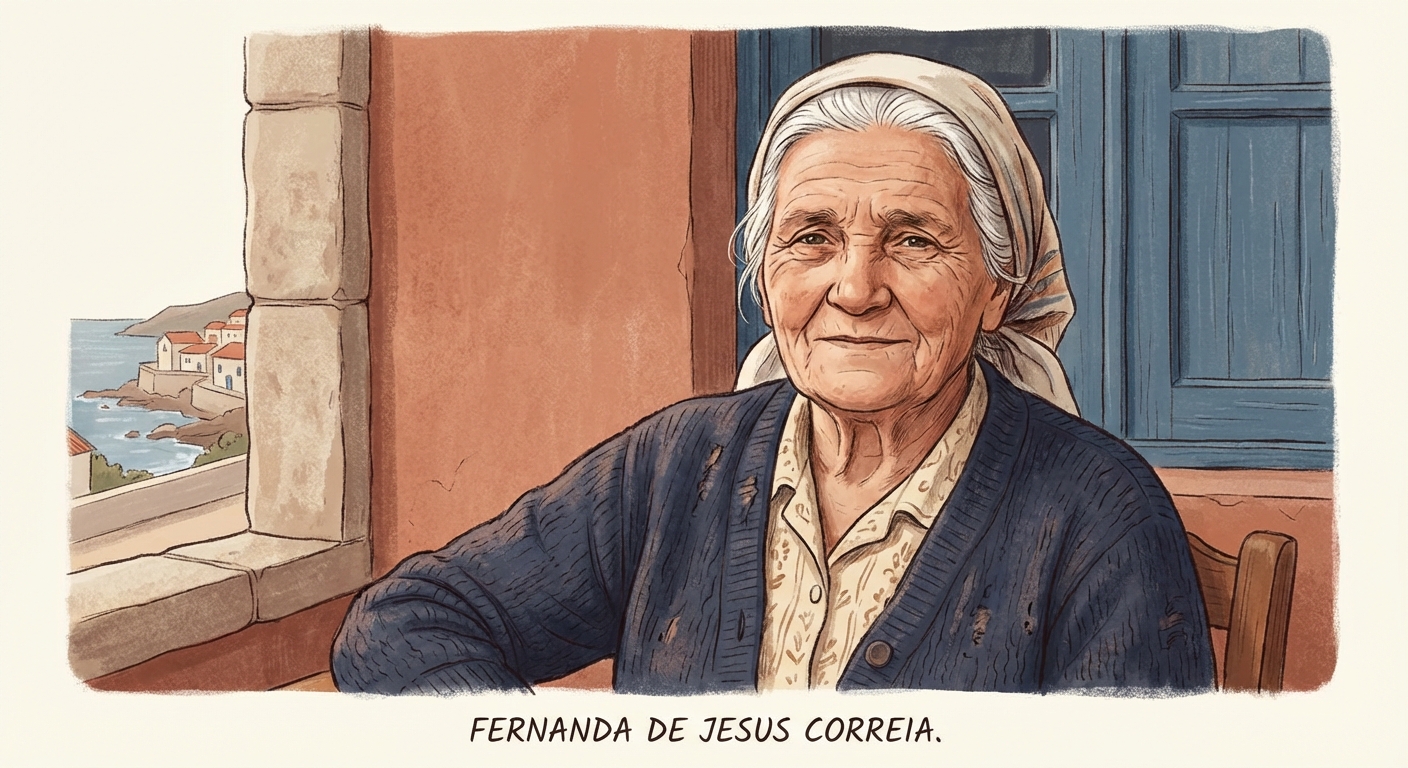
Fernanda de Jesus Correia
Top Concerns
Health/medication costs
"My pills cost more than food some weeks."
Loneliness
"Everyone left or died. I talk to the TV."
Pension adequacy
"€380 doesn't go anywhere anymore."
Healthcare access
"The health center has no doctors. What if something happens?"
Dying alone
"I don't want to die without my children knowing."
Background
Fernanda worked in fish canning from age 14 until the factory closed when she was 52. Her hands still remember the cold, the scales, the repetitive motion. Her husband Manuel was a fisherman; he died of lung cancer 12 years ago, likely from decades of smoking and sea air.
Now she lives alone in the small house they built together, surviving on a pension of €380/month—the minimum social pension because her work was often informal, undeclared, as most women's work was in those days. Her daughter in Lisbon sends €100/month when she can. Her daughter in France visits once a year, sends money at Christmas.
The Algarve around her has transformed. The town that was fishing and canning is now tourism and foreigners. Her neighbors on both sides are British retirees who don't speak Portuguese. She doesn't begrudge them—they're polite enough—but she feels like a stranger in her own town.
Her knees hurt. Her heart medication is expensive. The health center is understaffed. But she won't leave this house, where her children were born, where Manuel's memory lives in every room.
Economic Situation
Income level
Poverty level (€380/month + €100 from daughter)
Income source
Social Security minimum pension
Financial stress
Severe
Trajectory
Fixed income, rising costs
In Their Own Voice
"I don't recognize it anymore. My town is all foreigners and empty houses. The young left, the old are dying. The fish factory is a shopping center. I worked my whole life, and now I count coins for bread. Is this what Portugal promised us?"
— On Portugal
"Don't forget us. We're still here, the old ones. We remember when Portugal was different. We don't ask for much—just to live with dignity. Is that too much?"
— To Politicians
Hopes
For themselves
herself
"I want to stay in my home until the end. Not a nursing home, not a hospital—here, where Manuel and I lived. If I could see my grandchildren more..."
her grandchildren
"I want them to have good lives. Even if it's far away, even if I only see them on the phone. I just want them to be happy."
Personal fears
"Falling and not being able to get up. Having a stroke alone. Being found days later. Being a burden to my daughters."
What she'd say to someone who disagrees with her politically
"What do I know about politics? I just know what's fair. I worked 40 years, mostly without papers because that's how it was. And now my pension doesn't buy medication. That's not right, is it?"
Her message to politicians
"Don't forget us. We're still here, the old ones. We remember when Portugal was different. We don't ask for much—just to live with dignity. Is that too much?"
For Portugal
Portugal
"I hope they remember the old ones. We worked our whole lives. We deserve dignity at the end."
Fears for Portugal
"That the young ones all leave. That there's no one to care for the old. That Portugal becomes a country without Portuguese."
How she'd describe Portugal today
"I don't recognize it anymore. My town is all foreigners and empty houses. The young left, the old are dying. The fish factory is a shopping center. I worked my whole life, and now I count coins for bread. Is this what Portugal promised us?"
Fears
For themselves
Personal fears
"Falling and not being able to get up. Having a stroke alone. Being found days later. Being a burden to my daughters."
Her message to politicians
"Don't forget us. We're still here, the old ones. We remember when Portugal was different. We don't ask for much—just to live with dignity. Is that too much?"
For Portugal
Fears for Portugal
"That the young ones all leave. That there's no one to care for the old. That Portugal becomes a country without Portuguese."
How she'd describe Portugal today
"I don't recognize it anymore. My town is all foreigners and empty houses. The young left, the old are dying. The fish factory is a shopping center. I worked my whole life, and now I count coins for bread. Is this what Portugal promised us?"
What she'd say to someone who disagrees with her politically
"What do I know about politics? I just know what's fair. I worked 40 years, mostly without papers because that's how it was. And now my pension doesn't buy medication. That's not right, is it?"
Candidate Reactions
How this person would react to each candidate winning
PS (center-left)
António José Seguro
Key trigger: PS, pensions, familiar
PCP (Communist Party)
António Filipe
Key trigger: Workers' party; knows PCP helped old people
Independent ("My party is Portugal")
Henrique Gouveia e Melo
Key trigger: Respectable but doesn't know him
PSD/CDS backing (center-right)
Luís Marques Mendes
Key trigger: Seems nice enough
Bloco de Esquerda (left)
Catarina Martins
Key trigger: Women should help women; seems kind
Iniciativa Liberal
João Cotrim Figueiredo
Key trigger: Doesn't know him
Chega (far-right)
André Ventura
Key trigger: Seems aggressive; doesn't feel caring
Information Sources
Where they get their information
community
High TrustChurch, remaining neighbors, market vendors
online
Doesn't use
social media
None (no smartphone)
tv
High TrustRTP, SIC (on all day for company)
Voting History
Past electoral choices and patterns
Lifelong PS voter (working class loyalty)
PS
"Always have, they care about pensions"
PS
"For the workers"
Marcelo
"Good man, cares about people"