The Immigration Question
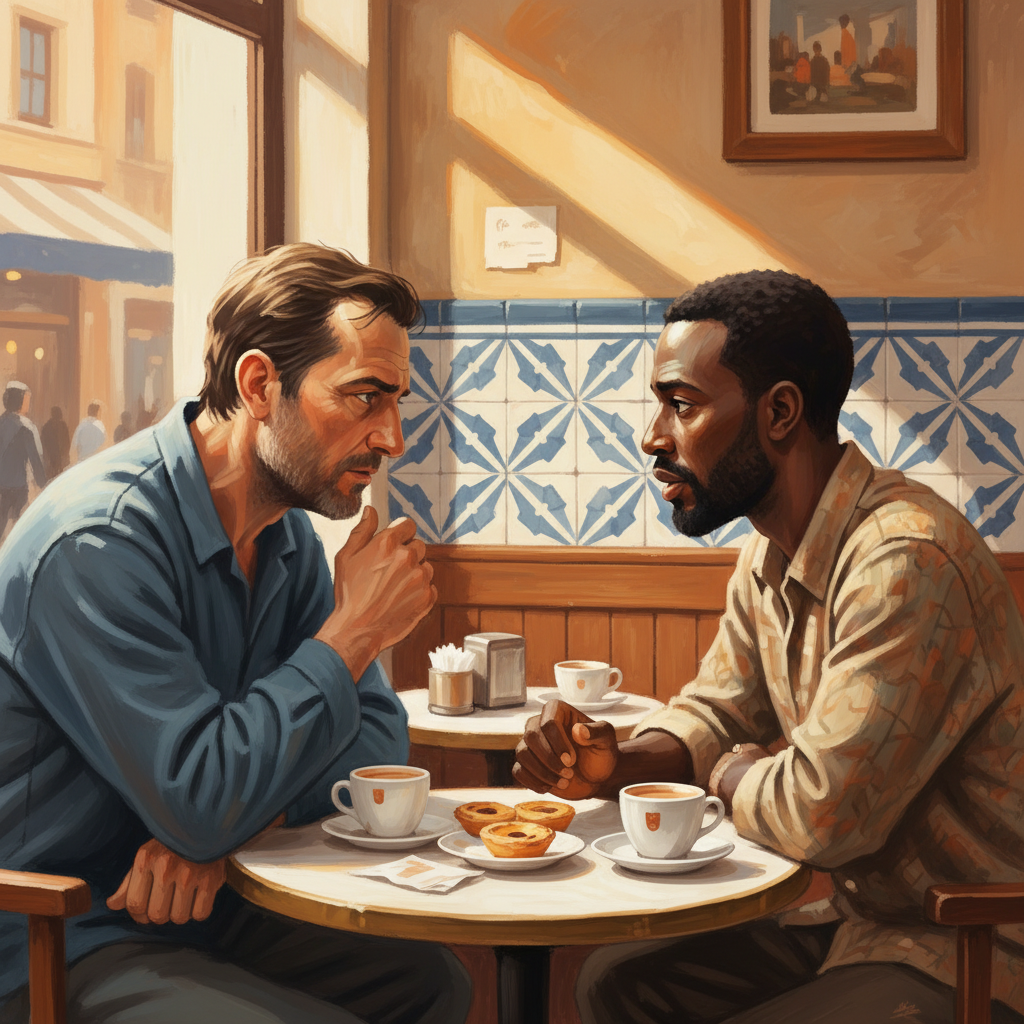
Who participates in this conversation
Pedro: finishes his beer Porto got robbed on that call. But anyway—you're from around here?
Wilson: Amadora. You?
Pedro: Setúbal. Working in Lisbon for a conference thing tomorrow. pause You sound like you grew up here.
Wilson: Born here. Parents came from Cabo Verde in the seventies. I'm as Lisbon as the Tejo.
Pedro: nods slowly Look, I don't have anything against you personally. I want you to know that.
Wilson: tenses slightly Why would you have something against me?
Pedro: I vote Chega. You probably figured from... I don't hide it. And I know what people assume. But it's not about people like you—born here, working, speaking Portuguese. It's about the system.
Wilson: The system that let my parents in? That made me a citizen?
Pedro: The system that forgot people like me while letting anyone walk in. The housing prices, the hospitals full, the wages stagnant—and then politicians say we need more immigration? For whom?
Wilson: pauses The wages were stagnant before the immigration surge. The housing crisis is about investment funds, not immigrants. I work in a hotel kitchen—we can't find Portuguese workers for some jobs. Not because of wages—because the work is hard and young Portuguese won't do it.
Pedro: Young Portuguese won't do it for those wages. If there were fewer workers, wages would rise. Basic economics.
Wilson: Maybe. But who built your buildings in Setúbal? Who cleans your office? Who cares for elderly Portuguese when their families won't? We're not taking—we're filling gaps.
Pedro: drinks Some of you, yes. But do you know what it's like in some neighborhoods? I'm not talking about you—I'm talking about communities that don't integrate, that stay separate, that bring problems—
Wilson: interrupts Which neighborhoods? Have you been to them?
Pedro: I've seen enough. The news. The crime statistics.
Wilson: The news that Chega shares? The statistics that count a Brazilian name and assume "immigrant crime"? My son was born here. Third generation. Should he be counted as immigrant crime if he gets a parking ticket?
Pedro: That's not what I mean—
Wilson: But that's what the rhetoric does. It doesn't distinguish. When Ventura says "too many," he doesn't mean workers in hotel kitchens. He means anyone who doesn't look Portuguese enough. Including me. Including my son. Including people whose families have been here for fifty years.
Pedro: silence I don't want you deported. I don't want your son harassed. I want... I want someone to acknowledge that things got worse for people like me, and maybe uncontrolled immigration is part of it. Maybe not all of it. But part.
Wilson: And I want someone to acknowledge that people like me are Portuguese. Not "good immigrants" or "integrated ones"—just Portuguese. When you vote for Ventura, you're voting for someone who will never see me that way. Whatever his policies, his message is: you don't belong.
Pedro: long pause I hear you. I don't agree with everything he says. I just... there's nobody else who even talks about the things I care about. PS ignored us. PSD ignored us. Chega at least speaks to the frustration.
Wilson: And what about my frustration? Fifty years my family has been here. Contributed, worked, paid taxes. And every election, I have to wonder if my neighbors will vote to make my life harder. That's exhausting too.
Pedro: I get it. finishes drink Look, we're probably not going to solve Portuguese politics in a bar. But... I hear what you're saying. It's not as simple as I sometimes make it.
Wilson: No. It's not. stands to leave I hope whoever wins, neither of us regrets it.
Pedro: Yeah. nods Take care.
Cross-cutting Patterns


Explore Futures
"The Portugal of True Portuguese"
André Ventura
"The Workers' Portugal"
António Filipe
"The Social European Project"
António José Seguro
"The Democracy of Care"
Catarina Martins
"The Technocratic Renewal"
Henrique Gouveia e Melo
"The Liberal Leap"
João Cotrim Figueiredo
"The Stable Continuity"
Luís Marques Mendes